Monday, 18 March 2013

Aldous Huxley vs George Orwell


I recently heard someone contrast Aldous Huxley's Brave New World (BNW) with George Orwell's Nineteen Eighty-Four (1984), arguing that in the build up to the year 1984 so much pressure was put on 1984 that everyone forgot about the alternative distopia: Brave New World.


Soma is the drug that everyone in Brave New World 
takes when they need to relax.


When I read 1984 I absolutely loved it. The bitter cynicism and alternate reality was a fantasy world, because the government in the UK was never as organised as the IngSoc party. Political softness and pandering to the general public for support has meant that I've never experienced the fear of the government that many had during the cold war. While the internet has surely made personal information more easily open to governmental abuse, so too the government has been forced to be more open, and scandal after scandal has shown that secrets rarely stay hidden. After all, it only ever takes one person to break a cartel! For a while 1984 was my favourite book (later replaced by Catch 22).

Yet when I read Brave New World something within me was deeply shaken and disturbed. I was absolutely horrified and it quite quickly became my most hated book. I frequently feel this when I watch and read things that I find are too real (the film 500 Days of Summer, for example). In one sense this shows a deep weakness of mine: that I have to live in a fantasy world to some extent, because reality is too shocking and disturbing for me a lot of the time. But I believe that this weakness can be a strength, as it lets me touch on what I feel is wrong with the world and in myself. Much like physical pain draws attention to something that needs fixing, so too emotional pain caused by media that 'hits a nerve' draws attention to things that need fixing in us and in our perception of the world.


The political ideology of IngSoc in 1984


While 1984 did not 'hit a nerve', BNW did, and it was only recently that someone articulated what disturbed me so much. They said that 1984 is a distopia where people are controlled by pain, but in BNW everyone is controlled through pleasure. Indeed, with the cold war and rise of communism, the fear and hype that surrounded the year 1984 was understandable. But with so much attention paid in that direction, few people asked whether the future would be as Huxley predicted.

In BNW people are subdued by the pleasure that they live for. Humans are no longer born but are made in labs, and are conditioned for the roles in life that they will lead. Menial workers, for example, are given a lower IQ and made physically stronger, to encourage job satisfaction, while scientists are given higher IQs. 

Everyone is encouraged to have sex with everyone else. Everyone belongs to everyone else in a physical sense, and therefore exercising this 'freedom' is encouraged as a source of pleasure. 

Everyone is also encouraged to take Soma holidays. Soma is a fictional drug that has no side effects or hangovers, and if life gets a bit stressful or tough you can change the dose depending on how long you need to go on holiday.

Thus the general population is kept placid and happy through amusing themselves. There is no end to the sources of pleasure and everyone is able to be as happy as they want. And yet there is nothing happy about the book at all. The characters themselves live in fantasy and life ultimately loses all meaning.

The irony here, of course, is that I find myself as one of these characters. While I don't identify with Winston Smith in 1984, I find BNW a painfully real account of life in Western culture, including myself. It is the very fact that we need to live in fantasy that makes us no different from the people in BNW. Our search for pleasure and satisfaction subdues us from doing difficult and challenging things. We end up self-medicating with 'Soma' or sex or work and ultimately only do what we feel comfortable doing.

While I won't suggest an answer here, I do thoroughly recommend the series Black Mirror, written by comedian Charlie Brooker, which tackles topics like this. The show works on many levels, and I suggest reading reviews and finding out a bit about Brooker's life and work to add to the experience.


Monday, 4 March 2013

An Inter-testamental History Lesson


Chapter two in my dissertation on 'The Conflict Between Obedience to God and Obedience to the State in the Book of Revelation' deals with second century Judaism as a backdrop for the political conflict of Christians vs Rome (which is essentially what Revelation is all about). I've found this absolutely fascinating, because as a Protestant my Bible wouldn't normally include deutero-cannonical literature (also known as the Apocrypha), yet a lot of it seems very relevant to understanding the type of attitude that Jesus argued against.


The Macabees by Wojciech Stattler

So here I would like to provide a brief introduction to the history between the OT and the NT for anyone who would like to know a bit about what happened between Ezra/Nehemiah and Jesus.

After the temple was rebuilt under Ezra and Nehemiah between 450 - 425BCE, the ruling Persian empire started to decline and became weaker and weaker. This is when the last books that we have in the Bible were written (1-2 Chronicles and Malachi were also written at this point).

Alexander the Great was born in 356BCE and very quickly expanded the Greek empire to all of Israel's neighbours and including Israel, easily taking over the weak Persian empire. After Alexander died in 323BCE, however, the Greek rule broke down quite quickly, and factions of Alexander's commanders split off in a large power struggle.

During this time the Egyptians (Ptolmaics) attacked and took over Israel from 315 - 198BCE. We don't know much about Israel's history at this point, but some of the Dead Sea Scrolls might have been written at this time.

After the Egyptians grew weak, the Syrians (Seleucids) attacked Israel, but they didn't get as far as Egypt. This happened in 198BCE and they stayed in Israel until 142BCE. During this time the Syrians tried to force the Jews into adopting Greek culture, which was very popular in the area after Alexander's conquests. Some of the Jews joined in whole-heartedly and actually tried hard to gain favour in the eyes of their Greek masters through building gymnasiums. Since the Greeks thought that circumcision was barbaric some Jewish men attempted to undo their circumcision through surgery in order to fit in at the public baths. Others, however, strongly opposed the Greek culture and everything that came with it.


A coin depicting Antiochus IV Epiphanes. The back shows Jupiter and reads, Basileos Antiochou Theou Epiphanous Niketorou, approximately meaning 'king Antiochus: god, revealed, victorious' (let me know if you think I've translated this wrong!).

This tension increased in 167BCE when the Syrians, under Antiochus IV Epiphanes, attacked and completely ransacked Jerusalem. Pigs were sacrificed on the altar to God in the temple, circumcision was made illegal and punishable by death, all copies of the Torah had to be burned and Jews were forced to sacrifice to Antiochus IV and eat pork or be executed. Some Jews followed along, others refused and paid with their lives. Finally, Antiochus set up a statue of Zeus in the Holy of Holies, which seems to be what Daniel described when he spoke of the "abomination that causes desolation" (Dan 9:27, 11:31, and 12:11).

In this context a man called Mattathias and his sons John, Simon, Judas, Eleazar and Jonathan strongly opposed the Syrians and formed a rebel army. They fought for years, and each time one brother died the next one took over the rebel movement. Eventually, through war and political turmoil, these rebels (also known as 'the Maccabees', which comes from the Aramaic word for 'hammer') set up Israel as a free kingdom. This kingdom lasted from 142 - 63BCE and was known as the Hasmonean Dynasty.

But this was not a time of peace, sadly. The most peace the Israelites got was when the last Hasmonean ruler took over from 76 - 67BCE, and she was known as Queen Salome.

In 63BCE the Romans invaded and took over right up to 400CE. During this time the Herodians took over ruling Jerusalem under Roman authority, and Jesus had his ministry in this context. When Herod Agrippa I died in 44CE, Israel was put under the governing of the prefect of Syria and thus ended the rulers of Israel until 1947.

Monday, 4 February 2013

The Enraptured Mind


"we might be wise to follow the insight of the 
enraptured heart rather than the more 
cautious reasonings of the theological mind."[1]
- A. W. Tozer


I’ve recently been reading Tozer’s classic, The Knowledge of the Holy, and came across this sentence. Throughout the work Tozer extensively quotes Frederick W. Faber, and this is his defence for doing so. In many ways I agree with Tozer’s sentiment, and I’m sure that, if pressed, he would clarify this statement, so I by no means wish to be pedantic. Instead, it simply made me think about this apparent dichotomy of worship and theology.

Is such a dichotomy a real distinction? Worship Central teach their students that all Christians are theologians, and I would agree with that. I applaud the Worship Central emphasis on theology because I believe that good theology inspires deeper worship, and good worship deeper theology. However, as a wise woman once said to me, “we might all be theologians, but some are better theologians than others”. 

What I believe Tozer is getting at in this sentence is the tendency for theologians to shy away from complete self-abandonment in an attempt at objective awareness. In this sense, therefore, I wholeheartedly agree that the enraptured heart that has encountered God is far more in tune with the life of the Godhead than the stale academic mind that refuses to be shamed by the unlearned (1 Cor 1:27).

But is there a positive reality? Far be it from me to simply critique if I cannot provide a positive solution!

I believe that genuine theology is done within worship, viz. that the study of God is a spiritual discipline.[2] Theology is very much faith seeking understanding, and the academic pursuit of God is primarily a pursuit. The ‘academic’ nature of it is simply a qualification, making it a sub-category in the art of spiritual discipline. The nature of theology as a sub-category is that it manifests as a outworking of faith: it informs and forms faith, which in turn seeks greater understanding again.

But this circle can also be seen in the discipline of worship. As the Spirit forms us and informs us in worship, so we leave desiring God more, which again leads us to worship him.

Two particular examples of this form of academic faith that I look up to are A. W. Tozer himself, and St. Augustine. Both these men express such deep passion for God in their academic pursuit, so much so that one gets a sense of the worship of God through reading their work. This is not to suggest that others do not engage in this form of theology, but I would argue that what I have aimed to express here is most manifest in the writings of these two men.

For me, Augustine articulates the heart of the theological quest with the words;


What then do I love when I love my God?”.[3]


[1] A. W. Tozer, The Knowledge of the Holy (Kent: STL Books, 1976), 21.
[2] Cf Dallas Willard, The Divine Conspiracy (New York: Harper Collins, 1998).
[3] St. Augustine, Confessions, trans. Henry Chadwick (Oxford: Oxford University Press, 1991), 185.

Monday, 28 January 2013

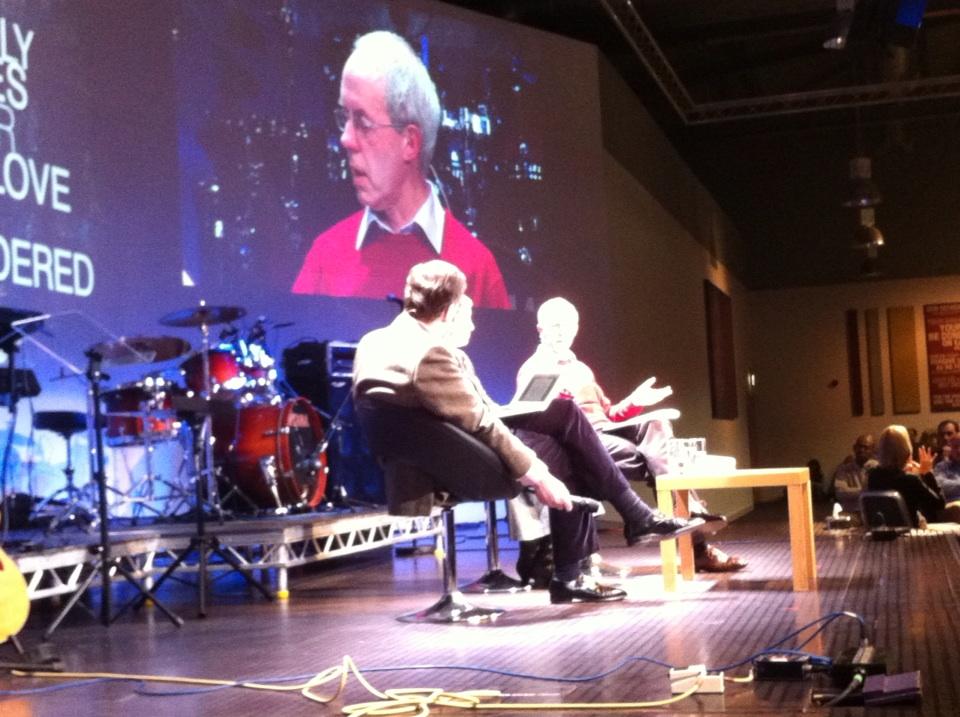
Justin Welby at Trent Vineyard


Justin and Caroline Welby are interviewed by John Mumford at Trent Vineyard Nottingham on Sun 27th Jan 2013. Image tweeted by John Wright (@CJohn_Wright).


It was a real pleasure to see the soon-to-be ArchBishop speak again. I first saw him speak at a youth conference on evangelism in Durham, and funnily enough his talk ('sermon' according to John Mumford) was the same; though clearly more developed! Nevertheless, he spoke with wisdom and clarity (as before), and I felt confident that he will make a good ArchBishop, even if he seemed to think the appointing didn't make sense! I would argue that there is great strength in Welby's detachment from the stifling academic environment (not to suggest that he is in any way unlearned, as he is clearly a very intelligent man), and that comes from someone who currently intends to go into academia! The tendency for academics to get lost in their own minds is such an obvious stereotype, and one that I see in myself! Therefore my readers have my permission to let me know if I ever encase myself in an ivory tower.[1] I hope that Welby will forgive my paraphrase of his talk, as I am writing from notes and memory rather than a recording.

Welby opened his talk with the assertion that the idols of this present age have fallen one after another; the financial crisis, the integrity of the media and politicians, the health system, the list goes on. He argued that today’s society is disillusioned with the present state, and that when everything fails only an empty cross and an empty tomb is left standing; thus Christ was the focal point of his talk. Because of this, now is the time for the church to be a light in the darkness, now is the time for social action and integrity, for genuine relationships with the person Jesus.

But how can the church go about this? Welby had five points all beginning with P;

Peace: Christians are to bring peace following Jesus’ example in Lk 24:36 and Jn 20:19. When the disciples are scared and lost because their world has crumbled around them, Jesus’ answer is to bless them with peace.
Presence: Like a certain monastic community in France, Christians are to affect change in the areas where they live. Christians should be present in difficult situations, and the positive change they bring should be evident.
Promise: When idols are falling there is a lot of cynicism and mockery. Christians should remember that God is faithful and true to his promises. In times of doubt we should be seeking the Spirit for affirmation of God’s love and constancy.
Purpose: The church must fill the gap left by state-run social programs that have lost their funding. A sense of purpose is important in times of uncertainty. Furthermore, social action will lead to opportunities to share the gospel, and every Christian should be able to explain the good news if such an opportunity occurs. Education was an example.
Power: The power that God gives us is always equal to the task that he calls us to do. In the Holy Spirit, God’s power takes control of the space left by broken idols.

Welby, like Dallas Willard in his fantastic book The Divine Conspiracy, was incredibly practical, something that is often forgotten for the more favoured spending ones “time in nothing but telling or hearing something new” (Acts 17:21).[2] The spiritual disciplines of prayer, reading the bible, fasting, and studying the bible (reading commentaries) all made an appearance, and there could have been others that I didn’t notice. Furthermore, practical evangelism was stressed, specifically; social action, practicing summarising the gospel, and having spiritual conversations.

I would like to re-iterate that I have paraphrased Welby’s talk and by no means should this be seen as a quotation. Instead I offer a humble interpretation of what was said.

Generally, all this made for a thoroughly enjoyable evening, from Caroline Welby’s intense description of their struggle with God’s will, to John Mumford’s comic interview technique. I appreciated the sense of church unity shown through the hosts Trent Vineyard, and I wish Justin and Caroline all the best as they step into this new role. I pray that God might keep them close to him and equipped in the power of the Holy Spirit.


[1] On this note, I found an incredibly useful roundtable discussion about careers in academia. It can be found here.
[2] Dallas Willard, The Divine Conspiracy (New York: Harper Collins, 1998).


Saturday, 26 January 2013

The Scandal of Grace


'Scandal of Grace' by Hillsong (2013)
The song on Youtube

When I first heard the title of Hillsong’s new release called “Scandal of Grace” I was extremely exited, as I assumed that this meant that the song itself would be shocking and scandalous in describing God’s extreme affection for humanity. Sadly I was very much disappointed, as there is nothing out of the ordinary about these lyrics! The use of the word “murdered” is about as shocking as it gets, and I think that ‘murder’ is a soft term to describe crucifixion!

The word scandal comes from the Greek word skandalon, which means “scandal, offense, cause of indignation”, and this indeed a great word to use to describe the Gospel![1] Jesus says in Mt 11:6 “blessed is anyone who is not scandalized by me”, thus implying that the gospel is offensive.[2] But how often do we hear an offensive gospel being preached? A gospel that might cause you to lose friends its so shocking? A gospel that could cause society to ridicule and hate you to the point of persecution? A gospel that would cause churches to reject your teaching because its too extreme? Maybe the reason why there is no persecution of Christians in the west is not because the west is so accepting, but because the gospel we preach is not as offensive as it used to be!

Grace is truly offensive, and Hillsong are completely correct to describe it as such, but I would suggest that their song is not a true reflection of how scandalous God's grace is.

Grace flies in the face of justice.[3] Grace redeems us while we were and are still sinners (Rom 5:8). Grace is free, and thus cannot be labelled “cheap” (contra Bonheoffer), as there is never a price attached! “It is for freedom that Christ has set us free” (Gal 5:1): Paul goes on to describe in Galatatians 5 that what Christ has set us free from is the Torah. We do not have a law system. We are no longer bound by rules. “Everything is permissible for me” (1 Cor 6:12): Here Paul is quoting the Corinthian church, who have understood grace so well that they continue to sin in their new-found freedom. Paul does not negate this phrase but qualifies it! Because of grace everything is permissible, but “I will not be mastered by anything”, nor is everything “beneficial”.

Thus Paul is able to say that “there is now no condemnation for those who are in Christ Jesus” (Rom 8:1), because life in the Spirit of God has set us free from a set of rules by which we live our lives. The new righteousness is not the Torah, nor the fulfilment of the Torah in a new set of rules (for example the 5 sermons in Matthew 5-7, 10, 13, 18, and 23-25, could be a new Pentateuch), but Jesus himself is the fulfilment of the Torah, not his words (Mt 5:17-18)![4] Righteousness is not to 'do' the sermon on the mount, or a new Torah, but it is Jesus himself. Rather, the person who “hears these words and does them” is wise (Mt 7:24-27). Jesus relates himself to what is worth being persecuted for; “righteousness” and “my sake” are synonymous terms (Mt 5:10-11).

Therefore, let us not bind people with rules, because righteousness is never found in not smoking or not drinking, nor not sleeping around, nor not murdering, nor even following the words of Jesus! Instead righteousness can only be found in his actual person. If we do what Jesus says we are wise, but we are not righteous. Church is for sinners only (1 John 1:8).


[1] William D. Mounce, Mounce Conscice Greek-English Dictionary of the New Testament (Accordance Bible Software: Version 2.0, 2011).
[2] NRSV reads “…who takes no offense at me”.
[3] A judge who accepts the life of one to pay for the penalty of another seems to be a very poor judge indeed, and I therefore do not agree with Penal Substitution. Instead it seems unjust, and by this great injustice we are set free.
[4] Regarding Mt 5:17-18; the Torah will pass away with heaven and earth, but Jesus words will not, thus implying that the Torah is temporal, but not Jesus' words. In this sense Jesus’ words are not simply a new Torah but infinitely and qualitatively different.


Sunday, 20 January 2013

A Theology of Django Unchained


Django Unchained (2012). Directed and written by Quentin Tarantino. 165 mins. Rated 18.

I heard someone comment on Inglorious Basterds (2009) that Tarantino had the entire audience laughing at the violence directed towards the Nazis. The irony is that there is a scene where the Nazis are laughing at the violence directed to the Russians in a cinema; thus Tarantino shows that his audience are no better than the Nazis, let alone the Jewish men who cause such violence themselves. In the same way, Calvin Candie (DiCaprio) is at one point sitting on a sofa watching a “mandingo fight” to his great enjoyment, yet at several points the crowd in the cinema delights in the slaughter and dismemberment of various characters. Tarantino has shown yet again that with a little justification (a great cause) the crowd assumes the role of the villain. Schultz’s (Waltz) desire to get into the fighting business is justified by the phrase “It seems like fun”, which could easily be a phrase used to justify going to see Django Unchained.

          The interesting thing about this film is that the higher cause that Django (Foxx) appeals to is not freedom for slaves but the salvation of his wife from the hands of the dragon (biblical imagery for satan, who initially seems to be Candie but is in fact Stephen (Samuel L. Jackson)). There is indeed Christological imagery here, as Christ defeats satan for his Bride, but the twist is that he does so through extreme violence and force. Shultz does attempt to simply buy Django’s wife back, which ultimately fails, but even before this Django’s answer is one of violence. In line with this, the subsequent freedom from slavery is also reminiscent of biblical imagery (Lk 4:8 = Is 61:1).

         Ultimately, however, I believe that this film is another classic case of Tarantino’s justice without mercy (viz. Inglorious Basterds and Kill Bill). Justice is stressed at the cost of everything, including principles. While Schultz refuses to shake the hand of Candie due to principles (commendably paying $12,000 for a slave is not a breach of his principles), Django fulfils his role as turncoat to the point of allowing a man to be torn apart by dogs. This is in contrast to the biblical witness, which instead demands mercy over justice, often to the extreme, as exemplified in the death of Jesus; where those who deserve punishment are forgiven completely. What this means for Django I don’t know, but what is evident in the film is that both white and black men can be slaves to each other (viz. Candie’s lawyer as a slave, Django and Stephen as masters), as well as incredibly evil to each other.

         In Kierkegaardian terms; Django apparently transcends the ethical in a leap of faith, by sacrificing his principles for the higher cause of his wife, when in fact he is simply esthetic in his desire for what is earthly through the following of his love for his wife at the cost of eternity. The real knight of faith would have given up his wife to God in full expectation of her return; a thoroughly unsatisfying answer for a non-Christian.

Friday, 18 January 2013

Book Review of 'The Heavenly Book Motif...' by Leslie Baynes


The Heavenly Book Motif in Judeo-Christian Apocalypses 200 BCE-200 CE (JSJSup 152), by Leslie Baynes. Leiden; Boston: Brill, 2012. Pp. vii + 233. £82.


My lecturer lent me this fantastic book to write a Biblical Theology of Heavenly Books, which would have been beyond my ability if it wasn't for this publication! Baynes provides a comprehensive and stimulating study of the heavenly books (the book of life, book(s) of deeds, book of fate and book of action) in biblical literature. The study itself is set within Jacques Derrida's concept of writing, with reference to Plato's Phaedrus, who argues that writing is always involved in questions of life and death.[1]
This book traces the progression of the motif through early biblical literature (Ex. 32:32-33 and Is 4:3) where there was no Jewish concept of eternal life, into later texts such as Daniel 7-12, which are to do with eternal life (Dn 7:10, 10:21, 12:1). Furthermore, Baynes traces the expansion and development of the motif in terms of authorship; starting with God in the OT, developing to Enoch in apocalyptic literature and finally the Son of Man in Revelation (Rev 3:5).
Baynes provides a convincing argument for the category of a book of action (Zech 5:1-5 and Rev 5:1-8) contra Richard Bauckham, who suggests that the scroll with seven seals in Rev 5:1-8 and the little scroll that John is told to eat in Rev 10:1-11 are the same scroll.[2] Baynes compares Rev 10:1-11 with Ezek 2:9-3:3 and categorises these as ‘heavenly letters’.[3]
The concepts of predestination and determinism frequently appear, but ultimately are left in tension with the significance of deeds, as the book of deeds continues into use in Revelation but the book of fate is left out of the NT. In Revelation, however, the book of life takes on the role of the book of fate (Rev 13:8 and 17:8). This tension is ultimately left unresolved; a tension that I believe is a reflection of the biblical witness.
Baynes’ writing style is accessible with a well structured approach of OT, ‘Inter-Testamental’, NT and early Christian writings. She includes discussions on the origin of the motif, positing Babylonian tablets of fate, as well as citizenship lists and royal records of deeds (Neh 7:5, Esth 2:23 and 6:1-3).[4]
Leo Koep’s Das himmlische Buch…, is an important text for Baynes’ study but is sadly unavailable in English. If I ever have time I might put the monograph on here.[5] Paul Shalom has also written an interesting article on this subject, and happily in English![6]
I strongly recommend this work for all studies on the heavenly book motif and the concepts of writing, fate, determinism and predestination in biblical literature.

Google books preview here.


[1] Jacques Derrida, “Platos Pharmacy,” in Dissemination (trans. Barbara Johnson; Chicago: University of Chicago Press, 1981), 65-171.
[2] Richard Bauckham, The Climax of Prophecy (Edinburgh: T&T Clark, 1993), 238-66. Cf Leslie Baynes, “Rev 5:1 and Rev 10:2a, 8-10 in the Earliest Greek Tradition,” JBL 129 (2010): 801-16.
[3] This seems to demand further study than the brief explanation on pages 52-54.
[4] Baynes, Heavenly, 46-51.
[5] Leo Koep, Das himmlische Buch in Antike und Christentum (Theophaneia: Beitrรคge zur Religions und Kirchengeschichte des Altertums 8; Bonn: Peter Hanstein Verlag, 1952).
[6] Shalom Paul, “Heavenly Tablets and the Book of Life,” JANES 5, (1973): 347. Kathleen M. O’Connor, “Jeremiah,” in Oxford Bible, 487.